Basket Tokens: A 16-Asset Arbitrage Graph on v4 Hooks (no chart)
Statics' core primitive: a basket token wrapping up to 16 underlyings — stock tokens like Nvidia, Tesla, Palantir (as-transcribed 'Planetyr') or meme coins — redeemable in-kind for exactly what's inside, weights never rebalanced. Instead of pairing baskets against ETH or a stablecoin, Statics creates Uniswap v4 pools with hooks pairing the basket against its own underlying, which builds an extensive arbitrage graph: the moment any underlying moves on an outside exchange, an opportunity opens between the basket and its components. Multi-asset flashloans let anyone rebalance — borrow the underlyings, mint baskets, sell into the pools, collect the difference, and pay only gas — in either direction. LP fees are paid in the basket token itself, so a three-asset basket pays fees in three tokens at once. The site confirms the design: 'every basket is a fixed bundle, always redeemable for exactly what is inside it — no manager, no rebalancing, no liquidations.'
Operator NFTs & the 14-Day Genesis Epoch
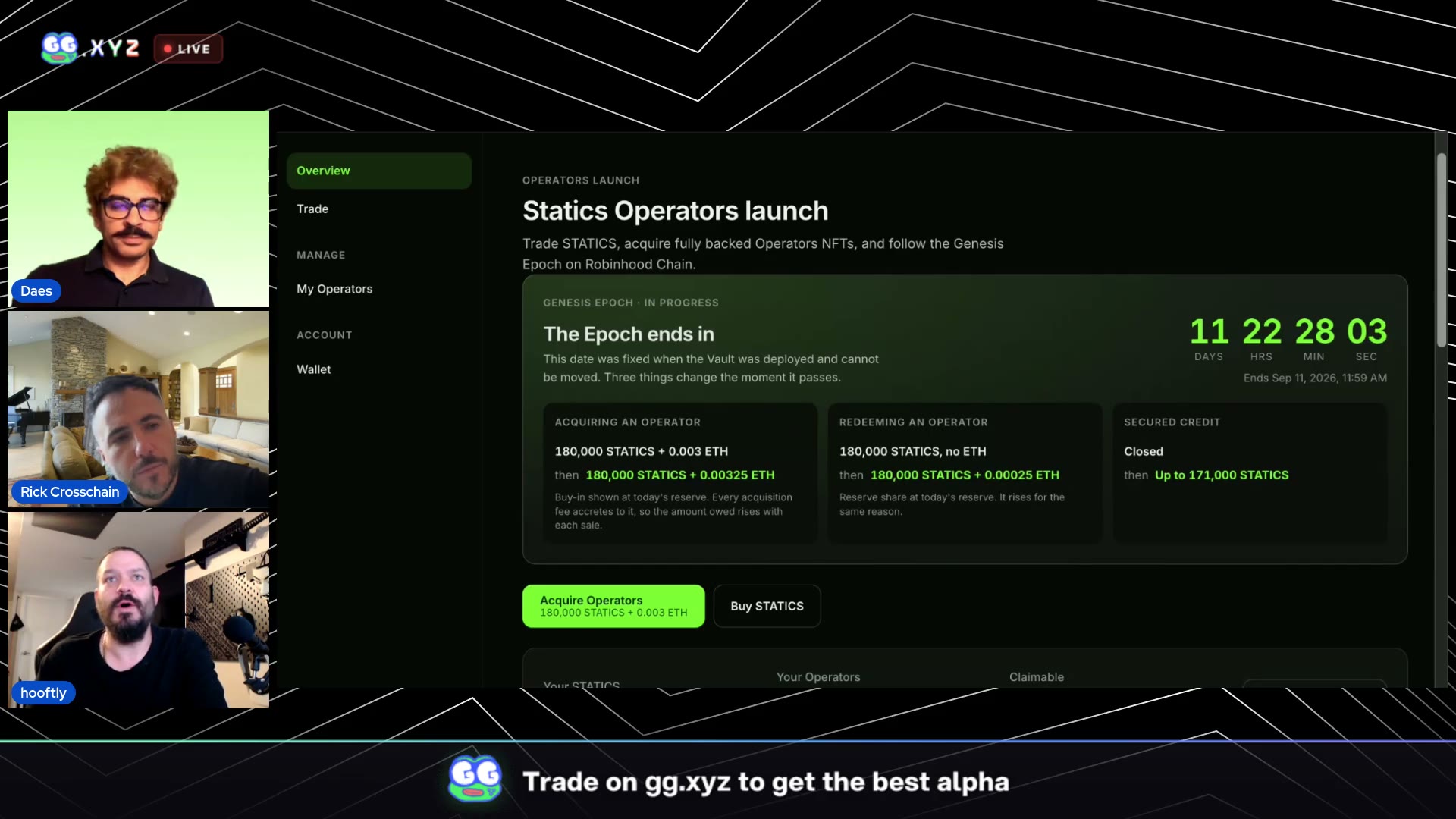
Live right now: operator NFTs that cost 180,000 STATICS plus a 0.003 ETH acquisition fee, which is thrown into a hard ETH reserve that is monotonic — the quantity can only go up (it had already grown 0.00025 ETH two days in). During the 14-day genesis epoch buyers skip paying into the reserve, paying only the acquisition fee; after the epoch the ETH component rises with the reserve. Holding an NFT isn't enough: registering it (gas only) qualifies for a base cut of statics-pool trading fees plus future fee revenue — currently one registered NFT is claiming 0.42% of all trading fees, about $5 over 24 hours. Activating costs STATICS (sent to the treasury for redistribution) and applies stake-weight multipliers from roughly 1.15x up to 1.25x at tier 4; when position NFTs go live, linking an operator NFT to one applies the same multiplier to staking. 'They just keep going up in reserve backing... once you acquire an NFT, the reserve starts growing from where you picked it up. Not financial advice.'
The Doppler Multicurve Launch: Front-Loaded Upside, Tapered Emissions
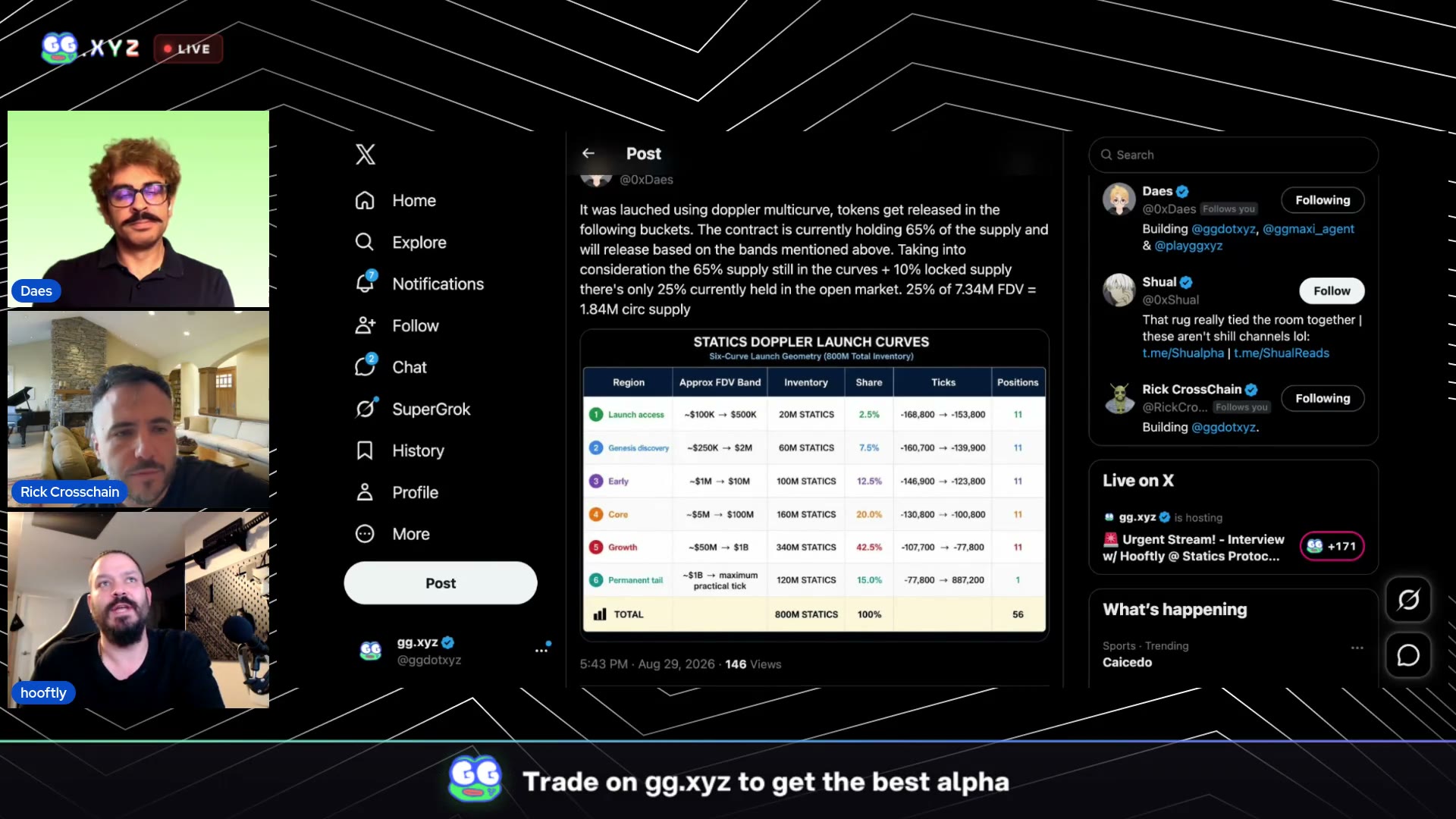
Hooftly chose Doppler's SDK — the Uniswap v4 token-launch protocol — for a custom multicurve rather than standard tokenomics, which he called 'flash-in-the-pan... designed to emit a crapload up front before even FDV.' The chosen bands give early traders meaningful upside in the first two bands, then emissions taper into the curve's core. He pegged the current state at roughly 200 million circulating supply, 'so we would be at about 2.2 million market cap' (as spoken) — noting DexScreener was displaying different numbers and he was working with them to fix it. Tokens only enter through this one pool, and once the basket system goes live, arbitrage between the curve and outside venues opens up quickly — 'there's only one way to get tokens, and it's from this pool.'
Baskets as a Volume Engine for Meme Coins (no chart)
Hooftly's strongest use case: projects can create real trading volume for their coin even when attention isn't there, because 'our bots don't care if your coin is trending — they care if there's a divergence, and that divergence brings trades, and those trades bring fees.' A project would pair its meme coin with liquid, volatile assets — WBTC was his example — since divergence drives the arbitrage. Denomination is fully flexible: you can set an underlying at 0.00005 BTC (a couple dollars' worth), keeping minting affordable while the arbitrage opportunity doesn't change. 'This is a way for projects who are struggling with attention or struggling with volume to pump that up a bit. Even a little bit helps.'
Self-Secured Credit: Borrow Your Own Liquidity, No Liquidations (no chart)
Once the epoch ends, the credit system goes live: NFT holders can borrow up to 95% of the STATICS backing their position ('in the vault'), accessing liquidity without losing yield — the NFT keeps earning while borrowed. There's no interest; instead a flat origination fee paid in ETH, split between the hard ETH reserve and the protocol treasury — so every loan pushes the reserve (and NFT cost) higher. Terms are 30 days with extension fees that can be stacked multiple months at origination; there's no health factor to monitor ('it's based on terms'), and defaulting means losing the NFT. Hooftly stressed this is not a standard CDP: 'you're not borrowing a different asset — this is the self-secured credit thesis in play,' and it needs no oracles. 'If you default, it's just a penalty. It's not a liquidation.'
Roadmap: Full Protocol Within ~a Month, Testnet Update 'in the Next Day or So' (no chart)
The rest of the protocol — position NFTs, the credit system, and the stablecoin — is targeted for launch within a month, 'as fast as possible,' at roughly two to four weeks depending on the speed of audits and vendors. The testnet update ships 'in the next day or so': staticsprotocol.com will offer a testnet selection with the full protocol in use on Robinhood Chain testnet (as-transcribed 'Robinhood testnet' — matching the broadcast title's 'RH Chain'), including a faucet. Community participation: join the Telegram, critique the GitHub, grab an NFT while Genesis pricing holds, and bounty airdrops are possible — 'we got lots of juice for incentives... get involved, and if you're involved and you're loud, you never know.'
USDstx: The Option-Based Stablecoin With No Liquidations (no chart)
Based on a design Vitalik posted 'a couple months ago': deposit roughly $1.50 of ETH to mint $1 of a fungible stable dollar plus a leveraged risk token — overcollateralized, option-series-based, and 'not CDP based.' The risk shares are the junior tranche, the stablecoin the senior tranche: if ETH drops below the safety band the system enters recovery mode rather than liquidating anyone — new mints on the risk-share side stop, the affected option series is frozen, and holders have 48 hours to return risk tokens to be automatically upgraded into the next series and paid the difference. Fail to return them and the position can be permissionlessly recovered — not a liquidation, but the caller takes a tip. A peg stability module (like Sky/Maker DAI) lets users deposit stablecoins to mint the same dollar, though its burning is disabled during recovery to prevent bank runs. The internal dollar ships as USDstx — the upcoming Morpho integration for basket tokens 'is going to be using USD STX, it's not going to be using USDG.'
Wrap-Up: 'The Next Andre Cronje' and PONS at $300M (no chart)
Post-interview, the hosts filled in the resume: they know Hooftly from 'Yves markets' (as-transcribed) — he has a whole prediction-markets product built as part of that project and shipped an entire custom Hyperliquid terminal and app, both of which may come under the Statics umbrella. Rick: 'For me he could be the next Andre Cronje — building all new primitives that will be pretty much used.' The macro read: 'A few weeks ago I was like, is meme coins going to take over still or will utility plays be the next thing in this cycle? Now we have certainty — it's about utilities, about DeFi. Robin Hood [stock tokens] is behind it.' Then the alpha share: Daes on PONS (as-transcribed 'pawns') — 'probably is gonna run to a billion. 300 million right now. Absolute crazy run' — with the thesis posted on GG ('look at the calls of pawns'); Rick: 'I think we had you early... the first one to post about it.' GG itself 'broke every metric today, yesterday.'